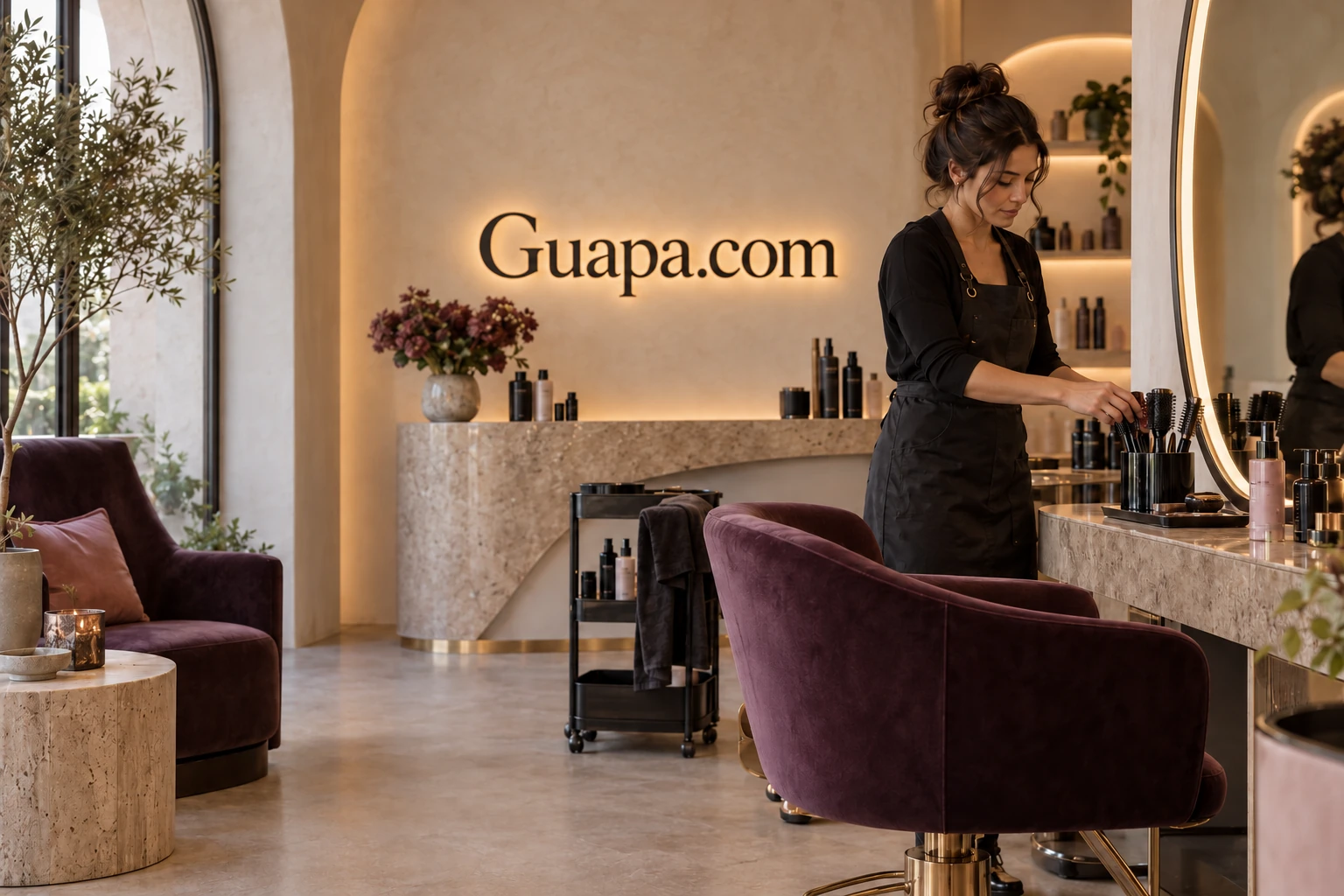
Guapa.com could greet clients as a salon name: a local beauty-service brand that borrows a warm Spanish dictionary word as the institution, not as a treatment label. The salon described here is an illustrative concept, with operations to be developed by a future owner. The first question is how a client will encounter the name: a recommendation, a search, a gift card, or the sign above the door.
A salon mark has to survive a phone referral, a map pin, a confirmation text, and the front-desk greeting. Treatment labels (“Curl Lab Midtown”) age when the menu changes. Guapa stays above the menu: hair, skin, brows, education, or retail can rotate underneath while the institution keeps one public word.
Illustrative appointment journey
Illustrative example: “Guapa” as a two-chair color studio in a bilingual neighborhood. Clients book a consultation, then a color appointment, then receive a 48-hour check-in text. The website shows services, stylists, and a single booking button. Gift cards print Guapa.com. Staff answer the phone with the same two syllables every time. Walk through the actual booking journey from the customer’s first search to the appointment confirmation (see the Blog post on salon booking friction).
Walk the journey on a friend’s phone before you fall in love with a logo. Discovery fails when maps returns a competitor first. Service choice fails when prices live only in a PDF. Slot pick fails when the calendar does not distinguish a confirmed slot from a request. Details fail when the form asks for a Facebook login. Confirmation fails when silence follows submit. A house name cannot fix those failures, but a consistent name helps a client identify the correct salon when the rest of the path works.
Buyer, offer, and local fit
The buyer is a salon operator or partnership who needs a memorable public word that prospective clients can test in conversation and referrals. The first offer is a defined service menu and an appointment path that does not leak mid-flow, with clear information for a first-time client.
Local fit checks before design:
- Say the name after one hearing; ask a neighbor to type it into Maps.
- Print a sample gift card and ask whether the letters feel right at that size.
- Call your own booking line and listen for how staff actually answer.
- Search existing salons and handles in your city for collisions that confuse clients.
- Check whether the name feels too informal for the service level you sell (bridal, clinical, luxury-price color).
Licensing, insurance, employment, and health rules stay with the operator. A future owner would establish the salon’s premises and booking operation separately. Domain ownership does not include a chair, a lease, or a book of clients.
Reach clients in the neighborhood
Salon distribution is neighborhood work dressed up as marketing. Practical paths:
- Claim and correct the Google Business Profile so the spoken name and the pin match.
- Partner with one nearby boutique or bridal shop for cross-referrals with clear boundaries.
- Seed a few local creators with a real service, not a fake “VIP launch” stack of unverifiable praise.
- Ask happy clients for a textable referral sentence that includes Guapa.com, not only “my colorist.”
- Use paid “salon near me” search only after the landing page and booking widget survive a guest checkout.
Repeat booking deserves its own clear path. Test a short check-in and rebooking link with existing clients before adding another application. For gift cards, ask a recipient to find the booking page using the card alone. Note the spelling they enter and the questions they ask before committing to a large print order.
Staffing and institutional identity
A founder using a surname can consider what would happen if the team or ownership changed. Ask prospective colleagues how the identity fits their role, and document how the business name and related assets would transfer. A house name like Guapa can make the institution larger than one person if you actually build systems: service standards, booking rules, and a brand voice that is not only the founder’s Instagram captions.
Practical institutional moves:
- One spoken greeting script for phone and front desk.
- One booking policy page clients can read before paying a deposit.
- Stylist bios that support the house without turning the site into twelve competing personal brands.
- Retail shelves (if any) labeled under the house name, with product claims kept honest.
If the long-term plan is to sell the salon, a transferable house name is part of the asset conversation. If the plan is a personal brand that will always be one artist, a surname may still be honest, and this Idea may not fit.
Execution load and limits
You still need chairs, scheduling software, deposit rules, and people who show up. The name gives the referral a consistent starting point. Website structure for services and booking can be simple: services, team, book, policies, contact. Fancy parallax does not recover a broken widget.
Compare this path with a product brand or an editorial masthead before you inquire. Salons are local and appointment-led. Product brands are SKU- and shipping-led. Editorial is cadence- and trust-led. Guapa.com can wear any of those, but the operator’s week looks different in each case.
Next step
Assess local fit, then inquire about Guapa.com with city, service focus, and how you handle bookings today. Mention any booking problem you are already working to solve.
Inquire about Guapa.com